3 beds 2 baths 1,170 sqft

$410,000 Income-Restricted 3-Bedroom Condo in South Boston: 1,170 Sq Ft Near the Broadway Red Line Station
For buyers searching for a 3-bedroom condo in Boston, an income-restricted homeownership opportunity in South Boston, a condominium near the MBTA Red Line, or a primary residence with central air and in-unit laundry, the property at 45 W Broadway Unit 101, Boston, MA 02127 offers an unusual opportunity—but it comes with important eligibility requirements that make it very different from a conventional Boston condo purchase.
Currently listed for $410,000 after a substantial $65,000 price reduction, this condominium provides approximately 1,170 square feet of living space, three bedrooms, one full bathroom, one half bathroom, central air conditioning, forced-air heating, an in-unit washer and dryer, and access to a professionally managed elevator building.
The property is located near the Broadway Red Line station, providing convenient access to Boston’s public transportation network. The surrounding area also offers access to shopping, highways, and other city amenities.
However, the most important fact about this property is not simply its price or location.
This is a City of Boston Inclusionary Development Unit / BPDA income-restricted condominium. The sale is subject to approval of the buyer’s eligibility, and the property carries deed restrictions. Buyers must satisfy household, income, asset, financing, primary-residence, and other requirements before purchasing.
Therefore, anyone considering this condo should carefully review the current Boston Planning Department and Mayor’s Office of Housing requirements and confirm eligibility before spending significant money on inspections, financing, or other transaction costs.
Property Overview: 45 W Broadway Unit 101, Boston, MA 02127
The condominium is currently offered at $410,000.
It contains approximately 1,170 square feet of finished interior living space.
There are three bedrooms, one full bathroom, and one half bathroom, making the structured bathroom count 1.5 baths even though the headline displays two bathrooms.
The unit is located in a 44-unit professionally managed elevator building.
It includes central air conditioning, forced-air heating, an in-unit washer and dryer, public water, public sewer, and an intercom security system.
The property does not include a basement or fireplace.
Parking is listed as on-street rather than a deeded garage or dedicated parking space.
The monthly HOA fee is approximately $1,034.
Price Reduced by $65,000
One of the biggest recent changes is the $65,000 price reduction reported on September 12.
The current asking price is now $410,000.
For buyers researching Boston real estate, a price reduction of that size naturally attracts attention. But this property’s restricted status means its price should not be compared mechanically with unrestricted market-rate condominiums.
Income-restricted properties operate under special rules designed to preserve affordability and homeownership opportunities for qualifying households.
Those restrictions can influence who may purchase the property and how ownership works in the future.
Approximately $350 Per Square Foot
Based on the $410,000 asking price and approximately 1,170 square feet, the property is listed at around $350 per square foot.
Price per square foot can be useful when comparing physical properties, but it has limitations here.
An unrestricted South Boston condo and a BPDA income-restricted condo are not financially identical assets.
The deed restriction and eligibility requirements are fundamental parts of this property’s ownership structure.
A buyer should therefore focus on whether the unit fits their household and finances rather than simply comparing $350 per square foot with unrestricted nearby listings.
Three Bedrooms in Boston
One of the property’s strongest practical features is its three-bedroom configuration.
Finding a three-bedroom property within Boston at this price level can attract attention, particularly from households that need multiple bedrooms.
The additional rooms may accommodate children, family members, a home office, or other household needs consistent with applicable occupancy requirements.
Because this is an income-restricted property, however, household composition matters directly to eligibility.
Prospective buyers should confirm the applicable requirements before assuming they qualify.
1,170 Square Feet of Living Space
The condo provides approximately 1,170 square feet of finished living area.
All 1,170 square feet are reported above ground in the listing data.
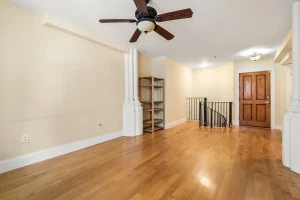
For a three-bedroom city condominium, the floor plan potentially provides a practical balance between private bedrooms and shared living areas.
Prospective buyers should review the actual layout, room dimensions, storage, natural light, and unit placement during a showing.
One Full Bathroom and One Half Bathroom
Although the listing headline shows two bathrooms, the detailed information identifies one full bathroom and one half bathroom.
This distinction matters.
A half bathroom normally provides a toilet and sink but not a shower or bathtub.
For a multi-person household, having an additional half bathroom can still provide meaningful convenience compared with a property containing only one bathroom.
Buyers should evaluate the bathrooms’ condition, storage, ventilation, fixtures, and layout.
Central Air Conditioning
The unit includes central air conditioning.
This can be an attractive feature during Boston’s warmer and more humid summer periods.
Central air can provide more consistent whole-unit cooling than relying exclusively on portable or window equipment.
The buyer should confirm maintenance responsibilities for HVAC equipment through the condominium documents and inspection process.
Forced-Air Heating
Heating is described as forced air.
Interestingly, the HOA information indicates that heat is included among the association services.
Prospective buyers should verify exactly how heating costs are allocated and what components inside the unit remain the owner’s responsibility.
Understanding what the HOA fee includes is important when comparing this property with another condo that has a lower monthly fee but requires owners to pay more utilities separately.
In-Unit Washer and Dryer
The property includes an in-unit washer and dryer.
For city condominium living, private laundry can be a major convenience.
Residents do not need to depend on a shared laundry room or travel to an outside laundromat.
The washer and dryer are also specifically identified among the included appliances.
Included Kitchen Appliances
The listing states that the property includes a range, dishwasher, microwave, refrigerator, and freezer.
These appliances can reduce immediate move-in expenses compared with a property requiring buyers to purchase a full appliance package.
Buyers should still confirm the age and condition of each appliance during a showing or inspection.
Included does not necessarily mean new.
Professionally Managed 44-Unit Building
The condo is located within a 44-unit professionally managed building.
Professional management can help coordinate maintenance, common-area responsibilities, snow removal, budgeting, insurance, and other association functions.
Buyers should nevertheless review the condominium’s financial documents.
A professionally managed building can still face future capital projects, reserve requirements, or special assessments.
Elevator Building
An elevator is included among the condominium amenities.
This can improve convenience for residents, visitors, groceries, luggage, and moving.
Elevators also represent a significant building system that requires maintenance and eventual capital investment.
Because this expense is shared through the condominium association, reserve funding and building financial health are worth understanding.
Monthly HOA Fee of $1,034
The condo carries an HOA fee of approximately $1,034 per month.
That is a significant recurring cost and should be incorporated into affordability calculations from the beginning.
However, evaluating the fee requires understanding what is included.
According to the listing, the HOA covers heat, gas, hot water, water, sewer, building insurance, structural maintenance, grounds maintenance, snow removal, trash, elevator access, and reserve funds.
Therefore, buyers should not compare the $1,034 fee directly with another building’s $400 or $500 fee without comparing included services.
What the HOA Fee Means for the Monthly Budget
A buyer’s housing budget includes much more than the mortgage payment.
For this property, a simplified ownership calculation would include:
Mortgage Principal and Interest + $1,034 Monthly HOA + Property Taxes + Unit Insurance + Any Utilities Not Included + Maintenance + Other Applicable Ownership Costs = Effective Monthly Housing Cost
The listing’s estimated monthly payment should not replace a personalized calculation from a lender.
Zillow’s Estimated $4,294 Monthly Payment
The supplied listing displays an estimated payment of approximately $4,294 per month.
This is an online estimate rather than a guaranteed financing quote.
Actual mortgage costs depend on the buyer’s down payment, interest rate, loan product, credit profile, insurance, and other factors.
The BPDA program also has specific financing and buyer-contribution requirements that need to be incorporated into the calculation.
BPDA Income-Restricted Property
This is the most important section for potential buyers.
The property is described as a City of Boston Inclusionary Development Unit / BPDA Income Restricted condominium.
It is not simply a discounted market-rate condo available to anyone who can pay $410,000.
The purchaser must qualify under the applicable program requirements and receive approval.
The deed-restricted status should be understood before making an offer.
Household Requirements
The listing states that buyers must satisfy household-related requirements.
Prospective purchasers should verify the current occupancy and household rules directly through the program, particularly because program requirements can be detailed and may change.
The listing also states that buyers must complete an affidavit and receive BPDA approval.
Submitting an offer alone does not establish eligibility.
Income Limits Reported in the Listing
The listing provides specific household income ranges.
For a one-member household, the stated range is approximately $120,000 to $144,000.
For a two-member household, the stated range is approximately $137,200 to $164,640.
For three household members, the listing gives approximately $154,300 to $185,160.
For four members, it states approximately $171,400 to $205,680.
For five members, the reported range is approximately $185,200 to $222,240.
For six members, the listing states approximately $198,900 to $238,680.
The listing advises buyers with larger households to request the applicable limits.
These figures should be independently confirmed as part of the application because eligibility is determined by the responsible program, not by an article or advertising summary.
Liquid Asset Limit
The listing also states that buyers must have less than $100,000 in liquid assets, with most retirement and education accounts excluded according to the listing.
This requirement is another reason buyers should establish eligibility early.
Someone may satisfy the income requirements but fail another program requirement.
Buyers should ask exactly which assets are counted and what documentation is required.
Mortgage Financing Is Required
The listing states that buyers must obtain mortgage financing.
That means this is not structured as an ordinary cash purchase opportunity.
A prospective buyer should work with a lender familiar with deed-restricted or income-restricted Boston properties when possible.
The lender needs to understand both the mortgage underwriting and the program’s requirements.
Minimum Buyer Contribution
According to the listing, the BPDA requires buyers to contribute at least 1.5% of the purchase price from their own savings, except when using a VA loan.
At a $410,000 purchase price, 1.5% equals approximately $6,150.
That does not mean $6,150 is the buyer’s total cash requirement.
Closing costs, lender requirements, prepaid expenses, reserves, and other transaction costs can increase the amount needed.
The figure represents the stated minimum buyer contribution requirement described in the listing.
Primary Residence Requirement
The unit must be the buyer’s primary residence.
This is critically important for investors.
The property should not be approached as a conventional Boston investment condo for someone seeking to buy it purely as a rental property or second home.
The program’s occupancy requirements and deed restrictions govern the property.
Anyone considering future rental arrangements should obtain clear guidance about what is and is not permitted.
Deed-Restricted Ownership
The listing terms identify the condo as deed restricted.
A deed restriction can affect future resale, buyer eligibility, occupancy, pricing, and other ownership rights.
Potential purchasers should obtain and carefully review the actual restriction.
A real-estate attorney familiar with Boston income-restricted housing can help explain the obligations before closing.
Why Future Resale Rules Matter
A buyer purchasing an income-restricted unit should understand not only how to qualify today but also how the property can eventually be sold.
The future buyer may also need to qualify.
There may be restrictions affecting resale pricing and the process for transferring ownership.
These provisions are essential to understanding the financial characteristics of the property.
It should not automatically be evaluated like an unrestricted condo purchased primarily for market appreciation.
Built in 1900
The building is reported as having been constructed in 1900.
That gives it a long history, although the listing does not specify when the property was converted, renovated, or developed into its present condominium configuration.
Buyers should review available condominium and building records to understand major improvements.
A building’s original construction year does not tell the entire story if major systems have subsequently been modernized.
Public Water and Sewer
The condominium is connected to public water and public sewer.
Water and sewer costs are also listed among the services included in the monthly association fee.
This makes the monthly HOA fee more comprehensive than one that covers only common-area maintenance.
Intercom Security
The building includes an intercom system.
In a multi-unit urban building, controlled visitor communication can improve everyday convenience.
Buyers should examine the building entrance, common areas, package arrangements, and other practical aspects of building access during a showing.
No Fireplace or Basement
The unit has no fireplace and no basement according to the structured listing information.
For buyers, this means there are fewer private auxiliary spaces to maintain.
Storage availability should therefore be investigated during a showing, particularly for a household occupying three bedrooms.
On-Street Parking
Parking is listed as on street.
There is no dedicated garage or deeded parking space identified in the supplied information.
For some Boston buyers, this could be an important consideration.
Prospective owners should investigate local parking regulations, resident permits where applicable, typical availability, and their transportation needs before purchasing.
Close to the Broadway Red Line Station
One of the property’s most attractive location features is its proximity to the Broadway MBTA Red Line station.
Access to rapid transit can be particularly valuable for households commuting within Boston or connecting to other parts of the regional transportation network.
The listing also identifies access to public transportation, shopping, highways, and a T station among the community features.
South Boston Location
The property is located in South Boston, an urban area offering access to downtown employment, restaurants, shopping, transportation, and other city services.
For buyers who prioritize public transit and city living, the location may reduce dependence on a private vehicle.
That can be especially relevant because the condo does not include dedicated parking.
Tax Assessed Value of $502,800
The property has a reported tax assessed value of approximately $502,800.
That figure is higher than the $410,000 asking price.
However, buyers should not interpret the difference as guaranteed equity.
The property’s income restriction and deed restriction distinguish it from unrestricted market-rate real estate.
Tax assessment and resale value are separate concepts.
Annual Property Taxes of $1,887
Annual property taxes are reported at approximately $1,887.
Buyers should verify the current tax treatment and whether any residential exemption or program-specific treatment affects this figure.
Future taxes can change, so the latest information should be incorporated into the household budget.
No Zillow Zestimate
No Zillow Zestimate is displayed for the property.
That is not particularly surprising for a deed-restricted income-qualified condominium.
Automated valuation tools can struggle with properties whose resale and eligibility conditions differ materially from unrestricted comparable units.
Program rules and the deed restriction are more important than a conventional automated estimate.
74 Days on Zillow
The property has reportedly been on Zillow for approximately 74 days.
That marketing period should be considered alongside the unusual buyer qualification requirements.
A restricted unit has a smaller eligible buyer pool than a property available to every financially qualified purchaser.
Time on market therefore cannot be interpreted in exactly the same way as an unrestricted Boston condominium.
10,884 Views and 478 Saves
According to the supplied data, the listing has generated approximately 10,884 Zillow views and 478 saves.
Those numbers indicate considerable online interest.
Zillow also displays a marketing indicator suggesting the property may sell faster than many nearby listings.
Still, online views and saves do not indicate how many viewers satisfy the program’s income, asset, household, financing, and primary-residence requirements.
Understanding the $65,000 Price Reduction
The substantial price cut may bring the condo into consideration for more eligible households.
However, affordability should be evaluated using the complete monthly cost.
A lower purchase price reduces the amount financed, but the $1,034 monthly HOA fee remains an important recurring expense.
Mortgage qualification and program eligibility are separate issues.
A household might qualify for the BPDA program but still need lender approval for the mortgage and total monthly housing expense.
Mortgage Pre-Qualification
The listing encourages prospective buyers to become pre-qualified.
For this property, early financing preparation is especially important because mortgage financing is explicitly required.
Buyers should disclose the income-restricted nature of the unit to the lender from the beginning.
A lender familiar with BPDA transactions may be better positioned to explain documentation, underwriting, appraisal, and closing requirements.
Condo Document Review
Before purchasing any condominium, buyers should review the association’s governing and financial documents.
Important information can include annual budgets, reserve balances, recent meeting minutes, building insurance, planned capital projects, pending litigation if any, special assessments, owner-occupancy rules, and maintenance responsibilities.
With a $1,034 monthly fee, understanding exactly how association money is spent becomes particularly important.
Reserve Funds and Future Building Projects
The HOA services reportedly include contributions to reserve funds.
Reserves are intended to help associations prepare for major future expenses.
For a building originally dating to 1900, buyers may want to understand plans for roofing, masonry, elevators, plumbing, heating systems, common areas, windows, or other major components.
Strong reserves can reduce—but not eliminate—the possibility of future special assessments.
Building Insurance Versus Unit Insurance
Building insurance is listed among the HOA-covered services.
That does not necessarily eliminate the buyer’s need for an individual condominium insurance policy.
Condo owners commonly need coverage for personal property, interior improvements, liability, loss assessments, and other risks not covered by the association’s master policy.
The association documents and insurance agent can clarify the appropriate coverage.
Why This Is Different From a Typical Boston Investment Property
A market-rate Boston condo might be evaluated primarily through appreciation potential, rental income, and unrestricted resale value.
This property requires a different approach.
The primary questions are whether the buyer qualifies, whether the unit works as their primary residence, whether the complete monthly payment is affordable, and whether they understand the deed restrictions.
That makes the property particularly relevant to qualified owner-occupants rather than conventional real-estate investors.
Budgeting for the Complete Monthly Cost
The $410,000 purchase price is only one component.
A buyer should budget for mortgage principal and interest, the $1,034 HOA payment, approximately $1,887 in reported annual property taxes, individual condo insurance, utilities not covered by the association, maintenance inside the unit, and other personal housing expenses.
This complete calculation provides a much more realistic affordability picture.
Potential Advantages for an Eligible Buyer
For the right household, several characteristics may be attractive.
The property offers three bedrooms and 1.5 bathrooms in South Boston, approximately 1,170 square feet, central air, in-unit laundry, an elevator building, professional management, and convenient Red Line access.
The HOA also bundles several significant operating expenses.
Most importantly, the income-restricted structure creates a homeownership pathway designed for households meeting specific program criteria.
Important Questions Before Making an Offer
Before proceeding, a prospective buyer should confirm current household eligibility, income calculation rules, asset limits, financing requirements, required buyer contribution, primary-residence obligations, resale restrictions, HOA finances, special assessments, unit condition, and total monthly housing costs.
The buyer should also review the deed restriction and condominium documents with appropriate professionals.
These steps are especially important because eligibility requirements affect the transaction itself.
Final Thoughts on 45 W Broadway Unit 101, Boston, Massachusetts
45 W Broadway Unit 101, Boston, MA 02127 is a distinctive Boston homeownership opportunity because it combines a $410,000 asking price, three bedrooms, approximately 1,170 square feet, central air conditioning, in-unit laundry, professional building management, an elevator, and convenient access to the Broadway Red Line station.
The recent $65,000 price reduction makes the headline price particularly noticeable.
However, the most important feature is the property’s status as a BPDA income-restricted, deed-restricted condominium.
This status changes how the property should be evaluated.
It is not an unrestricted investment condo available to any buyer.
The purchaser must satisfy the applicable eligibility requirements, obtain mortgage financing, meet the program’s asset and household rules, use the property as a primary residence, provide the required contribution from personal savings where applicable, complete the necessary affidavit, and receive approval.
The supplied listing reports household income ranges from approximately $120,000–$144,000 for a one-person household up through $198,900–$238,680 for a six-person household, with additional limits available for larger households. Because eligibility rules can be detailed, all figures should be confirmed directly during the application process.
The financial analysis also needs to include the $1,034 monthly HOA fee.
While substantial, the fee reportedly includes heat, gas, hot water, water, sewer, building insurance, structural and grounds maintenance, snow removal, trash service, elevator access, and reserve funding. Buyers comparing this condo with another property should compare the total cost of ownership rather than HOA fees alone.
The building’s age—reported as 1900—also makes condominium-document review important. Buyers should understand reserve funding and upcoming capital projects even though the building is professionally managed.
For transportation-oriented households, proximity to the Broadway Red Line station may be particularly valuable, especially because parking is listed as on-street rather than dedicated.
The property’s reported 10,884 Zillow views and 478 saves over 74 days demonstrate significant online attention, although only a subset of interested viewers may satisfy the program’s eligibility requirements.
Ultimately, this property is best understood not simply as a discounted Boston condo, but as a regulated homeownership opportunity with specific financial and occupancy requirements.
For a household that meets those requirements and wants three bedrooms in South Boston, the combination of space, central air, private laundry, elevator access, professional management, public transportation, and the reduced $410,000 asking price may make 45 W Broadway Unit 101 worth investigating carefully.
Before making an offer, prospective buyers should verify their BPDA eligibility, obtain appropriate mortgage pre-qualification, review the deed restriction and condominium documents, investigate the association’s financial health, understand the full $1,034 monthly HOA obligation, and calculate their complete monthly housing cost.
Those steps will provide a far more accurate picture of affordability and long-term ownership than the asking price alone.


Listed on Zillow