2 beds 1 baths 728 sqft
$32,000 Fixer-Upper Manufactured Home Near the Suwannee River in Live Oak, Florida: 2 Bedrooms, Private Well, Septic and 0.28-Acre Lot
For buyers searching for an affordable Florida fixer-upper, manufactured home investment, inexpensive property near the Suwannee River, or renovation opportunity under $50,000, the property at 17987 14th Ter, Live Oak, FL 32060 presents an interesting combination of a low acquisition price, existing utilities, a metal roof, two storage sheds, and a location within a laid-back river community.
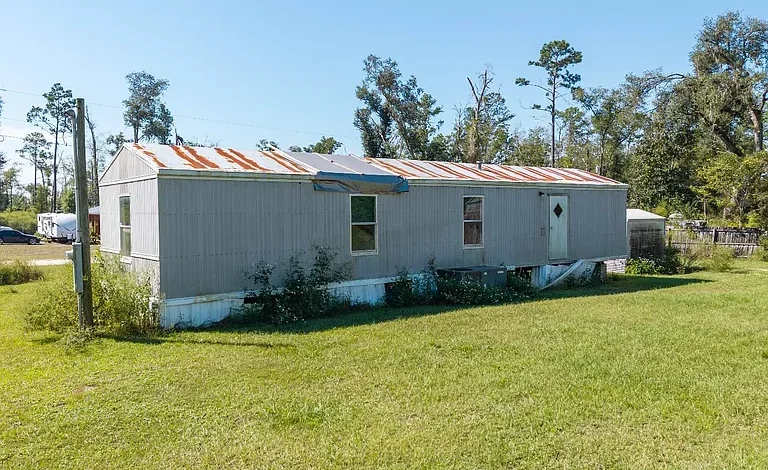
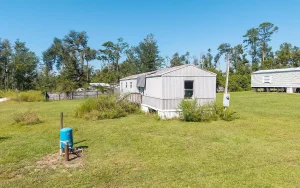
Currently offered at $32,000, this 1996 single-wide manufactured home provides approximately 728 square feet of living space, with two bedrooms and one full bathroom. The property sits on approximately 0.28 acres in the Suwannee River Park Estates area and is described as being within a short walk of the Suwannee River.
The listing is very clear that the home requires significant repairs and TLC. That makes this property more appropriate for a buyer who understands renovation costs than someone expecting a move-in-ready home at an unusually low price.
At the same time, several existing improvements could be meaningful. The property reportedly has a 144-foot-deep private well, an existing septic system that was pumped in 2024, central electric heating, central air conditioning, a metal roof, front porch, deck, driveway parking, and two sheds.
Another important detail is the seller’s statement that the property is not located in a flood zone. Because of the property’s proximity to the Suwannee River, buyers should independently confirm the current official flood designation and investigate insurance requirements rather than relying exclusively on listing language.
The property is also being marketed with the possibility of purchasing the neighboring property under MLS #133459, which could create an additional option for a buyer interested in controlling more land or pursuing a larger investment strategy.
With an asking price of $32,000 and a Zillow Zestimate of approximately $63,300, the listing may initially appear to offer a substantial discount. However, that difference should not be treated as guaranteed equity. The condition of the manufactured home, repair costs, title status, insurability, comparable sales, and land value all need to be evaluated before determining the property’s true financial potential.
Property Overview: 17987 14th Ter, Live Oak, FL 32060
The property is a single-wide manufactured home built in 1996.
It contains approximately 728 square feet of interior living space with two bedrooms and one full bathroom.
The home sits on a 0.28-acre lot and is currently offered for $32,000, equivalent to approximately $44 per square foot based on the listed living area.
Construction information identifies a frame structure with vinyl siding, a metal roof, aluminum-frame windows, and a pillar/post/pier foundation.
Utilities include a private well and septic tank.
Heating is listed as central electric, while cooling is provided by central air conditioning.
There is no HOA reported.
Annual property taxes are approximately $401, and the reported tax assessed value is approximately $30,165.
Understanding the $32,000 Asking Price
A $32,000 residential property will naturally attract attention in today’s housing market, particularly when the purchase includes land, a private well, septic system, and existing manufactured home.
However, the seller explicitly states that the home needs significant repairs.
That means the correct financial analysis begins with the asking price but does not end there.
A buyer should calculate:
$32,000 Purchase Price + Closing Costs + Inspections + Structural Repairs + Interior Renovation + HVAC Work + Electrical + Plumbing + Well/Septic Work + Insurance + Taxes + Site Improvements + Holding Costs + Contingency = Total Investment
That final number is what should be compared with the property’s realistic value after repairs.
Approximately $44 Per Square Foot
The listing calculates the asking price at approximately $44 per square foot.
For a 728-square-foot property, the low total price is more important than the price-per-square-foot figure by itself.
Manufactured homes also need to be analyzed differently from conventional site-built houses.
Age, condition, land ownership, title status, foundation configuration, roof condition, utility systems, financing eligibility, and insurance availability can all influence value.
A low price per square foot does not automatically mean the property is undervalued.
728 Square Feet of Living Space
At approximately 728 square feet, this is a relatively compact residence.
Smaller homes can have several renovation advantages.
There is less flooring to replace, less interior wall area to paint, fewer rooms to heat and cool, and generally less total space requiring cosmetic improvement.
However, fixed expenses such as a septic repair, well problem, electrical panel replacement, or HVAC replacement do not necessarily become proportionally cheaper simply because the home is small.
This is why the condition of major systems is especially important.
Two-Bedroom Layout
The manufactured home contains two bedrooms.
A two-bedroom configuration can work well for an individual, couple, small household, retirees, or tenants who want a second room for guests, an office, or storage.
For an investor, two bedrooms can provide a broader tenant market than a studio or one-bedroom property.
The listing does not provide individual room dimensions, so buyers should inspect the layout personally.
In a 728-square-foot home, efficient use of space can make a significant difference in how large or small the property feels.
One Full Bathroom
The residence contains one full bathroom.
For a two-bedroom home of this size, a single bathroom is a typical and practical configuration.
During renovation, buyers should pay particular attention to the bathroom because water damage can create problems beneath the visible surfaces.
The tub or shower, toilet, sink, subfloor, wall materials, plumbing, ventilation, and fixtures should all be inspected.
If the bathroom requires a complete renovation, the cost should be included in the project budget before purchase.
Built in 1996
The manufactured home was built in 1996.
That makes it roughly 30 years old in 2026.
Age alone does not determine whether a manufactured home is a good investment.
Maintenance history is more important.
A well-maintained 1996 home can remain functional, while a poorly maintained property can require substantial rehabilitation.
Buyers should investigate previous repairs, roof history, water intrusion, HVAC condition, electrical systems, plumbing, flooring, subfloor condition, and structural supports.
Significant Repairs and TLC Required
The seller does not attempt to present this as a move-in-ready home.
The listing specifically states that it needs significant repairs and TLC.
That language should guide buyer expectations.
The first inspection should focus on whether the property is structurally and mechanically worth renovating.
Cosmetic issues such as outdated paint, flooring, cabinets, and fixtures are relatively straightforward.
Structural deterioration, extensive water damage, electrical problems, HVAC failure, or damaged subfloors can change project economics much more dramatically.
Pillar, Post and Pier Foundation
The foundation is identified as pillar/post/pier.
This type of support system is common for manufactured housing.
A professional familiar with manufactured homes should inspect the piers, supports, leveling, anchors, tie-downs, moisture conditions, and underside of the structure.
Uneven support can cause floors, doors, windows, cabinets, and walls to move out of alignment.
Florida’s weather and wind considerations make proper anchoring another important issue.
Metal Roof
The property has a metal roof.
Metal roofing can be a desirable feature because properly installed and maintained systems may provide long service life.
However, the listing does not specify the roof’s age or condition.
Buyers should check for corrosion, loose fasteners, failed seals, damaged flashing, previous leaks, and problems around roof penetrations.
Interior ceilings and walls should also be examined for signs of past water intrusion.
A metal roof should be considered an asset only after its current condition is understood.
Vinyl Siding
The exterior is identified as vinyl siding over frame construction.
Vinyl siding can be relatively low maintenance compared with some traditional exterior materials.
An inspection should still look for cracked or missing panels, moisture intrusion, impact damage, improper installation, and deterioration underneath the siding.
The lower sections of manufactured homes also deserve attention because moisture, pests, and ventilation problems can affect the underside of the structure.
Aluminum-Frame Windows
The listing identifies aluminum-frame windows.
Window condition affects comfort, energy efficiency, moisture management, and insurance considerations.
Buyers should check whether windows open and close correctly, whether glass or frames are damaged, and whether water has entered around the openings.
Replacing windows throughout a small home may be manageable, but it should still be included in the renovation budget if necessary.
Central Electric Heating
The home reportedly has central electric heating.
This means the property already has a central heating system rather than relying solely on portable units.
However, the listing does not identify the age or operating condition of the equipment.
A licensed HVAC technician should inspect the system.
A low-cost property can become considerably more expensive if the heating and cooling system needs immediate replacement.
Central Air Conditioning
The home also has central air conditioning.
In Florida, dependable cooling is particularly important.
The HVAC system should be evaluated for age, refrigerant type, duct condition, electrical components, drainage, airflow, and overall performance.
Manufactured-home ductwork can sometimes be located beneath the structure, making inspection of the underside especially useful.
If significant repairs are already required elsewhere, understanding HVAC costs early helps prevent budget surprises.
Private 144-Foot Well
One of the most interesting infrastructure features is the reported 144-foot-deep private well.
Having an existing well can eliminate the need to drill a completely new water source if the system is functioning correctly.
However, depth alone does not establish water quality or system condition.
Buyers should investigate the pump, pressure tank, electrical connections, water pressure, flow rate, and water quality.
A professional water test may also be appropriate.
Why Well Inspection Matters
Private well ownership differs from municipal water service.
The owner is responsible for the equipment and maintenance.
A failed pump, pressure tank, electrical component, or well-related issue becomes the homeowner’s expense.
For a rental investor, reliable water service is essential before a tenant occupies the property.
Testing the existing system before purchase can therefore provide valuable information for the renovation budget.
Septic System Pumped in 2024
The listing states that the septic system was pumped in 2024.
That is useful maintenance information, but pumping does not necessarily prove that every part of the system is in excellent condition.
A buyer should determine the septic tank’s condition, drain-field performance, system location, capacity, and any maintenance history available.
A septic inspection may identify issues that would otherwise become expensive after closing.
Private Utilities and Operating Costs
With a well and septic system, the property does not rely on monthly municipal water and sewer services in the same way as an urban residence.
That can reduce certain recurring bills.
However, the owner becomes responsible for maintaining private infrastructure.
A prudent long-term budget should include reserves for future well-pump and septic expenses.
0.28-Acre Lot
The property sits on approximately 0.28 acres.
That provides more outdoor space than many dense urban properties while remaining relatively manageable.
A buyer may have room for parking, outdoor seating, storage, landscaping, and recreational equipment.
The exact usable area should be evaluated on site, including setbacks, septic components, well location, drainage, and property boundaries.
Front Porch
The home includes a front porch.
A porch can enhance the relaxed character of a river-community property and provide an outdoor place to sit during suitable weather.
Because the home requires significant repairs, the porch should be inspected for structural stability.
Decking, steps, railings, supports, and connections to the manufactured home may all require attention.
Outdoor Deck
A deck is also identified.
Outdoor living space can be particularly appealing in a recreational area near the Suwannee River.
A renovated deck could provide room for chairs, a table, or other outdoor activities.
Wood exposed to Florida humidity and rainfall can deteriorate, so the deck should be inspected for rot, loose fasteners, unstable railings, and structural issues.
Two Storage Sheds
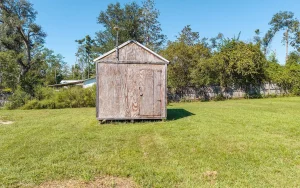
The property includes two sheds, one of which is identified as a prefabricated shed.
Additional storage is a practical advantage for a small 728-square-foot residence.
The sheds could potentially hold tools, lawn equipment, fishing gear, bicycles, recreational supplies, or other items that would otherwise occupy interior space.
Their roofs, floors, doors, and overall structural condition should be evaluated.
Driveway and 3+ Car Parking
The listing identifies driveway parking for three or more vehicles.
This is useful for a relatively small property.
Additional parking could accommodate residents, guests, work vehicles, boats, trailers, or recreational equipment where permitted.
The road surface is identified as graded, so buyers should inspect road conditions and determine who is responsible for maintenance.
Suwannee River Community
The property is located within the Suwannee River Park Estates area and is described as part of a river community.
The seller states that the Suwannee River is only a short walk away.
For buyers who enjoy fishing, boating, kayaking, or simply being near the water, this location may provide lifestyle appeal that a conventional neighborhood property does not.
The property itself should not be described as riverfront based on the supplied facts.
Proximity to the Suwannee River
Living near the Suwannee River can be attractive for recreational buyers.
A future owner might use the property as a permanent residence, seasonal getaway, fishing base, or weekend retreat.
However, proximity to a river makes flood research particularly important.
The seller states that the property is not located in a flood zone, but buyers should verify the current official flood map and insurance requirements independently.
Flood-Zone Verification
Flood designations can affect insurance, financing, building requirements, and long-term ownership costs.
Even if the residence is outside a designated high-risk flood zone, buyers may still want to understand local drainage and historical flooding.
A property’s flood-zone classification and its practical exposure to water are related but not identical questions.
Current official information should be used before making a purchasing or insurance decision.
A1 Zoning
The property is listed with A1 zoning.
Prospective buyers should verify what uses are permitted under the current local zoning rules.
This is particularly relevant if the buyer plans additional structures, recreational vehicle storage, another manufactured home, a workshop, rental use, or other changes.
The listing’s existing use does not automatically establish approval for every future project.
No HOA
There is no HOA reported.
For some buyers, this is a significant advantage because there is no listed recurring homeowners association fee.
It can also mean fewer private association rules.
However, zoning, county regulations, building codes, health requirements, and title restrictions can still apply.
“No HOA” should not be interpreted as “no rules.”
Tax Assessed Value of $30,165
The property has a reported tax assessed value of approximately $30,165.
That is relatively close to the $32,000 asking price.
Tax assessed value should not be treated as a professional appraisal or exact indication of market value.
Assessment methodologies differ, and property condition can affect what an actual buyer is willing to pay.
The figure is best treated as another data point.
Annual Property Taxes of Approximately $401
The listing reports annual taxes of approximately $401.
For a low-priced property, taxes remain an important part of the ownership budget.
Investors should include taxes when calculating annual cash flow.
Owner-occupants should also verify whether the current tax amount would change after a transfer of ownership or changes to the property.
Zillow Zestimate of $63,300
Zillow displays a Zestimate of approximately $63,300.
That is nearly double the $32,000 asking price.
It may be tempting to interpret the difference as immediate equity, but that conclusion would be premature.
The listing explicitly says the home requires significant repairs.
An automated estimate may not fully reflect current physical condition, renovation requirements, title characteristics, or local manufactured-home considerations.
A professional appraisal and comparable sales provide stronger evidence for valuation decisions.
Do Not Assume $31,300 of Instant Equity
The difference between the $63,300 Zestimate and $32,000 asking price is approximately $31,300.
That is mathematically correct, but it does not mean a buyer automatically receives $31,300 in usable equity.
If the home requires $20,000, $30,000, or more in repairs, the economics change immediately.
Closing costs, insurance, taxes, financing, and holding expenses also reduce the apparent spread.
The property’s true value depends on condition and market evidence.
Financing a Manufactured Fixer-Upper
Financing can be more complicated for an older manufactured home requiring significant repairs.
Lenders may consider the home’s age, title status, foundation, condition, land ownership, insurance, and whether it qualifies as real property.
Some buyers may use cash, while others may explore manufactured-home financing, local lenders, renovation products, or other options.
A lender should review the specific property before a buyer assumes conventional mortgage financing will be available.
Manufactured Home Title Due Diligence
One issue that deserves attention with any manufactured home is title status.
Buyers should verify whether the home and land are legally treated together as real property or whether separate manufactured-home title documentation exists.
This can affect financing, insurance, taxes, and resale.
A title professional familiar with Florida manufactured housing can help clarify the documentation before closing.
Insurance in Florida
Insurance is another major consideration.
Florida property insurance can vary significantly based on location, roof, age, construction, wind mitigation, condition, and other factors.
A buyer should obtain insurance quotes before finalizing the purchase.
The metal roof may be relevant, but its installation date and condition can matter.
Manufactured-home insurance requirements may also differ from those for site-built houses.
Fix-and-Flip Potential
An investor could evaluate the property as a renovation-and-resale project.
The basic equation should be:
Realistic After-Repair Value – $32,000 Purchase Price – Closing Costs – Repairs – Insurance – Taxes – Utilities – Financing – Holding Costs – Selling Expenses – Contingency = Potential Project Result
A conservative after-repair value should be based on comparable manufactured-home sales with similar land ownership, age, size, and location.
The Zestimate alone should not determine the project’s expected resale value.
Long-Term Rental Potential
A renovated two-bedroom home may also be evaluated as a long-term rental.
The river-community setting, private lot, parking, storage sheds, well, septic, central HVAC, porch, and deck may appeal to certain tenants.
However, rental rates should be researched using comparable properties in the Live Oak area.
A landlord should also budget for well and septic maintenance, HVAC repairs, insurance, property taxes, vacancy, and capital improvements.
Vacation or Recreational Property Potential
Because the property is near the Suwannee River, another possible use could be a personal recreational retreat.
A buyer might prefer a small 728-square-foot home because less interior space means less to maintain when the property is used only part-time.
The sheds could hold fishing or outdoor equipment, while the driveway may provide useful vehicle parking.
Any short-term rental plans would require separate verification of local regulations and insurance.
Neighboring Property May Also Be Available
An unusual opportunity mentioned in the listing is that the property can potentially be purchased with the neighboring property identified as MLS #133459.
This could be significant for a buyer wanting additional land, privacy, another residence, or a larger investment footprint.
However, the neighboring property should be analyzed independently.
Its price, condition, title, utilities, and permitted uses should all be reviewed rather than assuming that purchasing both automatically creates a better investment.
Renovation Priorities
For this property, renovation should begin with structural and moisture-related issues.
The foundation supports, subfloor, roof, exterior walls, windows, and signs of water intrusion should be examined first.
Next come electrical, plumbing, HVAC, well, septic, and other essential systems.
Once the home is safe and mechanically reliable, work can move to the kitchen, bathroom, flooring, walls, lighting, paint, appliances, porch, deck, and cosmetic exterior improvements.
Subfloor Inspection Is Important
Subfloor problems can be particularly important in manufactured homes.
Leaks from plumbing fixtures, roof failures, window intrusion, or long-term humidity can damage flooring materials beneath the visible finish.
Soft areas around bathrooms, kitchens, exterior doors, and windows deserve careful inspection.
Replacing surface flooring without repairing damaged subflooring would only hide the underlying problem temporarily.
Kitchen Renovation Strategy
The listing does not provide detailed information about the kitchen.
A buyer should inspect cabinets, countertops, sink plumbing, electrical outlets, appliances, flooring, and ventilation.
Because the home is only 728 square feet, a well-designed kitchen can have a major influence on the overall appearance of the interior.
For an investment renovation, durable and cost-conscious materials may make more financial sense than luxury finishes.
Bathroom Renovation Strategy
With only one bathroom, keeping it functional is particularly important.
The renovation should prioritize waterproofing, plumbing reliability, ventilation, safe electrical service, and durable materials.
A clean and modern bathroom can significantly improve the appeal of a small home without requiring an oversized budget.
Complete Renovation Budget
Before purchasing, an investor should estimate expenses for the roof, foundation supports, tie-downs, subfloor, siding, windows, HVAC, electrical, plumbing, well, septic, kitchen, bathroom, flooring, walls, paint, appliances, porch, deck, sheds, driveway, landscaping, permits, insurance, taxes, utilities, and financing.
A contingency reserve should then be added.
This is especially important because the seller has already disclosed that significant repairs are necessary.
Importance of a Contingency Reserve
Fixer-uppers frequently reveal problems that are not obvious during an initial walkthrough.
A small plumbing leak can hide extensive subfloor damage.
An HVAC system may operate during inspection but still be near the end of its useful life.
A septic problem can be expensive.
Moisture beneath a manufactured home can affect supports and flooring.
A contingency reserve helps protect the project from these uncertainties.
Early Zillow Interest
According to the supplied listing information, the property received approximately 271 Zillow views and 15 saves during its first day on the market.
That indicates early online attention.
The combination of a $32,000 asking price, river-community location, land ownership, well, septic, and existing home may contribute to that interest.
Still, online views and saves do not establish market value or guarantee competitive offers.
Final Thoughts on 17987 14th Ter, Live Oak, Florida
17987 14th Ter, Live Oak, FL 32060 offers an unusual opportunity for buyers willing to take on a substantial renovation project.
For $32,000, the property includes a 1996 single-wide manufactured home with two bedrooms, one bathroom, approximately 728 square feet of living space, and a 0.28-acre lot.
The existing infrastructure is particularly noteworthy.
The property reportedly has a 144-foot-deep private well, an existing septic system that was pumped in 2024, central electric heat, central air conditioning, a metal roof, driveway parking, a front porch, a deck, and two storage sheds.
Its location within the Suwannee River Park Estates community provides another dimension. The seller describes the river as being only a short walk away, creating potential appeal for buyers interested in fishing, boating, outdoor recreation, or a quiet Florida retreat.
At the same time, the home should not be mistaken for a turnkey bargain.
The listing specifically says it requires significant repairs and TLC.
The $32,000 asking price therefore needs to be combined with a realistic renovation budget before the investment can be evaluated.
The approximately $63,300 Zillow Zestimate is interesting but should not be viewed as guaranteed equity or a guaranteed after-repair value. The condition of the property and relevant comparable sales matter far more.
The reported $401 annual property tax keeps one current ownership expense relatively modest, while the absence of an HOA eliminates a listed monthly or annual association fee.
The well and septic system can also reduce dependence on municipal utilities, although they transfer maintenance responsibility directly to the owner.
Florida-specific due diligence is particularly important.
A buyer should verify flood-zone information, obtain an insurance quote, investigate the age and condition of the metal roof, inspect the manufactured home’s foundation and tie-down system, and confirm title status.
Because the property is close to the Suwannee River, the seller’s statement that it is outside a flood zone should be independently confirmed through current official information.
The possibility of purchasing the neighboring property could also be worth investigating for someone seeking additional space or a broader investment strategy.
For an investor, this property could potentially be considered for renovation and resale or long-term rental.
For an owner-occupant, it may provide an affordable way to establish a small home in a quiet river community.
For a recreational buyer, the compact home, sheds, parking, and proximity to the Suwannee River could make it useful as a weekend or seasonal retreat.
In every scenario, the same principle applies: the total project cost matters more than the initial purchase price.
A buyer who carefully evaluates the home, obtains realistic repair estimates, verifies insurance and flood considerations, inspects the well and septic system, confirms manufactured-home title documentation, and maintains an adequate contingency reserve will be in a much stronger position to determine whether this $32,000 Live Oak property fits their goals.
With the right renovation plan, 17987 14th Ter could potentially transform from a neglected single-wide into a compact Florida residence, rental investment, or peaceful retreat near one of the state’s best-known river systems.
Listed on Zillow