Cleveland Ohio Foreclosure Duplex With Finished Third Floor and 2,324 Square Feet for $30,000
Cleveland Ohio Foreclosure Duplex With Finished Third Floor and 2,324 Square Feet for $30,000
Affordable multi-family properties can offer a different kind of opportunity for real estate investors, particularly when the property already has a two-family configuration, multiple levels of living space, and off-street parking. In Cleveland, Ohio, a foreclosure property listed for $30,000 presents a potentially interesting renovation project for buyers who are comfortable taking on substantial repairs.
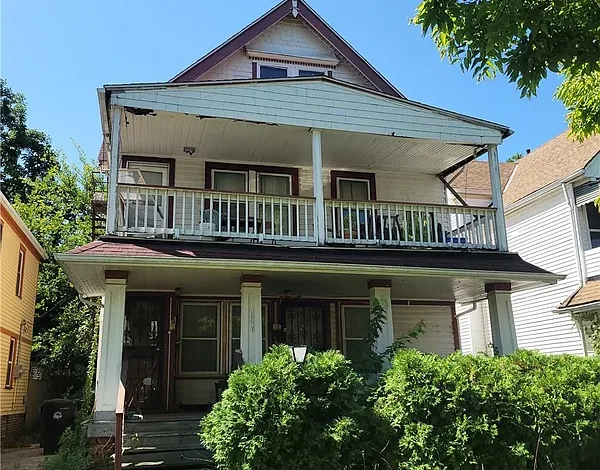
The property is a two-family framed Colonial built in 1916, offering approximately 2,324 square feet of interior living space. It includes four bedrooms, multiple bathrooms, a finished third floor, front porches on two levels, a full basement, and driveway parking. The property is located on a 4,199-square-foot lot and is connected to public water and public sewer.
The listing describes the property as a fixer and specifically warns that it has significant water damage. It is being sold strictly as-is. That detail is extremely important because the $30,000 asking price does not represent the total cost of acquiring and restoring the property.
For an experienced investor, however, the existing duplex configuration could provide a foundation for a future rental property, owner-occupied multi-family residence, or larger renovation project, subject to zoning, permits, building codes, property condition, and other requirements.
Because the property is listed as a foreclosure and Real Estate Owned property, prospective buyers should also complete careful title, inspection, legal, and financial due diligence before proceeding.
A $30,000 Cleveland Multi-Family Opportunity
The asking price of $30,000 immediately places this property in the category of low-cost real estate opportunities that can attract investors looking for renovation projects.
At approximately $13 per square foot based on the listing information, the asking price is low relative to the amount of interior space being offered. The property contains approximately 2,324 square feet of livable area, creating a substantial amount of space for the purchase price.
However, price per square foot can be misleading when a property has significant damage.
The listing specifically states that the property has significant water damage. Water damage can affect many components of a building, including flooring, drywall, ceilings, insulation, framing, electrical systems, plumbing, roofing, basement areas, and other structural or mechanical elements.
Therefore, the low asking price should be viewed as a reflection of the property’s condition and foreclosure status rather than as a simple discount on a move-in-ready home.
The investment calculation should begin with the complete project cost, including acquisition, renovation, permits, professional services, utilities, insurance, taxes, carrying costs, and potential contingency expenses.
A Two-Family Property With Multiple Living Areas
The property is identified as a duplex and multi-family residence.
That existing two-family configuration is one of the most significant features of the listing.
Instead of purchasing a conventional single-family property and attempting to convert it into multiple units, an investor is starting with a structure already marketed as a two-family property.
This could potentially make the property attractive to buyers interested in rental income.
A duplex can offer several possible ownership strategies.
An investor could potentially rent both units, assuming the units are legally permitted and brought into appropriate condition.
An owner-occupant could potentially live in one unit while renting the other, subject to financing, zoning, occupancy, and local regulations.
Another possibility could be renovating both units and eventually selling the property as an income-producing multi-family asset.
The finished third floor adds another layer of potential flexibility, although its legal status and permitted use must be verified.
Finished Third Floor
One of the features highlighted by the listing is the finished third floor.
The property is described as a two-family Colonial with a finished third floor that provides flexible living space above the upper unit.
This is an unusual feature for a property at this price point.
A finished third floor can potentially be used as additional living space, storage, office space, recreational space, or another permitted purpose. However, finished does not automatically mean legally recognized as a bedroom or independent dwelling unit.
Buyers should verify ceiling height, emergency exits, windows, heating, electrical service, insulation, fire separation, access, and other building-code requirements.
If the third floor is currently being used as living space, the buyer should determine whether that use is legally permitted.
If it is not, the renovation plan may need to account for changes before the area can be marketed as habitable space.
Four Bedrooms and Multiple Bathrooms
The listing reports four bedrooms and two bathrooms in its primary property facts, while another section of the listing identifies three full bathrooms.
Because the listing contains this discrepancy, prospective buyers should verify the exact number and configuration of bathrooms during inspection and through official property records.
This distinction matters for both valuation and renovation planning.
A duplex with multiple bathrooms can provide greater flexibility for tenants and owners. If the property does have three full bathrooms, as one portion of the listing states, that could be particularly useful when evaluating the existing layout.
The four-bedroom configuration also provides a substantial amount of residential space.
Investors should determine how the bedrooms are distributed between the two units and whether all bedrooms meet applicable requirements for legal sleeping areas.
Approximately 2,324 Square Feet
The property contains approximately 2,324 square feet of total interior livable area, according to the listing.
The same figure is listed for the total structure area and finished area above ground.
That amount of space can provide considerable room for a duplex renovation.
For an investor, the actual floor plan is just as important as the total square footage. Two properties with the same amount of living space can have very different renovation costs and rental potential depending on their layouts.
A buyer should determine the approximate size of each unit, the location of kitchens and bathrooms, entrances, stairways, utility systems, and the relationship between the main units and the finished third floor.
A professional inspection and measured floor plan can help establish what space is actually usable.
Significant Water Damage
The most important warning in the listing is the presence of significant water damage.
This should be treated as a major due-diligence issue.
Water damage can originate from many sources, including roof leaks, plumbing failures, drainage problems, basement water intrusion, broken windows, inadequate gutters, or long-term moisture exposure.
Before purchasing, buyers should attempt to identify the source and extent of the damage.
Questions to investigate include:
- Where did the water enter the property?
- Is the source still active?
- Has the roof been repaired?
- Are there damaged structural components?
- Is there mold or microbial growth?
- Has insulation been affected?
- Are electrical systems exposed to moisture?
- Is there damage behind walls or ceilings?
- Has the basement experienced flooding?
- Is the foundation structurally sound?
- Are floors level and stable?
- Has the property been vacant for an extended period?
The answers can dramatically affect the renovation budget.
Why Water Damage Can Change the Investment
A property with cosmetic problems can often be renovated relatively predictably.
A property with significant water damage is different.
Water can remain hidden behind walls, under flooring, inside ceilings, or around structural components. If the source is not corrected, new repairs can quickly deteriorate.
For an investor, this means the renovation should begin with identifying and stopping the source of water before cosmetic work begins.
Depending on the property’s condition, remediation may involve roofing, gutters, drainage, plumbing, structural repairs, drywall replacement, flooring removal, insulation replacement, electrical work, and mold-related services.
A professional inspection is therefore particularly important.
The buyer should also consider hiring specialists where appropriate rather than relying only on a general inspection.
Full Basement Adds Another Area to Inspect
The property includes a full basement.
A full basement can provide useful storage and mechanical space, but in a property with significant water damage, the basement deserves special attention.
Buyers should inspect the foundation walls, floor, drainage, sump system if present, plumbing, electrical equipment, and signs of previous flooding.
Basement moisture can be a recurring issue if the underlying drainage problem is not corrected.
Potential sources include groundwater, poor grading, foundation cracks, damaged gutters, downspouts, sewer backups, or other drainage issues.
The basement should not be treated as additional finished living space unless its condition and legal status support that use.
1916 Colonial Architecture
The property was built in 1916 and is described as a framed Colonial.
A home of this age can contain architectural features that are difficult to reproduce in newer construction.
The Colonial design may provide traditional proportions and a layout that can appeal to buyers seeking older housing stock.
At the same time, a 1916 building may contain several generations of repairs and alterations.
Investors should pay particular attention to the structural framing, foundation, roof, electrical system, plumbing, windows, siding, insulation, and heating system.
The property is constructed with wood siding and has an asphalt/fiberglass roof according to the listing.
The roof condition is especially important because of the reported water damage. If the roof is the source of the problem, repair or replacement may need to be completed before interior restoration.
Front Porches on Two Levels
The listing highlights front porches on both levels.
Porches can provide valuable outdoor living space and contribute to the traditional appearance of an older Colonial-style property.
For a multi-family property, separate porch areas may also provide useful outdoor space for occupants.
However, older porches should be inspected carefully.
Important areas include support posts, beams, flooring, railings, stairs, roof structures, flashing, and connections to the main building.
Any porch that has experienced prolonged water exposure may require structural repair.
Off-Street Driveway Parking
The property includes driveway parking.
Off-street parking can be a meaningful feature for a multi-family property, particularly when tenants have access to dedicated parking without relying entirely on street spaces.
The listing does not provide extensive information about the exact number of vehicles the driveway can accommodate, so buyers should inspect the property and determine how the parking arrangement works.
Potential investors should also verify whether local regulations require a specific number of parking spaces for a duplex.
If future renovation plans involve additional living space, parking requirements could become especially important.
Public Water and Public Sewer
The property has public water and public sewer.
Municipal utilities can simplify certain aspects of ownership compared with properties using private wells and septic systems.
However, buyers should verify the condition of the interior plumbing and the service connections.
A property built in 1916 may have plumbing that has been repaired or replaced multiple times.
A professional inspection can help identify leaks, deteriorated pipes, inadequate drainage, or other concerns.
Because the property is a duplex, buyers should also investigate how water and other utilities are distributed between units.
Separate meters, shared systems, or unusual utility arrangements can affect the property’s operating expenses and rental management.
Forced-Air Heating and No Listed Cooling
The property has forced-air heating.
The listing does not identify a cooling system.
In a renovation project, heating and cooling should be evaluated together.
A buyer should determine whether the existing heating system is operational, how old it is, whether it serves both units, and whether the system is appropriately sized.
If cooling is desired or required for marketability, the buyer should investigate available options and associated costs.
Depending on the property’s configuration, adding central air or other cooling systems may require electrical upgrades, ductwork changes, or additional equipment.
Real Estate Owned Foreclosure
The property is listed as Real Estate Owned, or REO, and the listing identifies foreclosure as a special condition.
REO properties typically require additional attention to title, condition, transaction procedures, and documentation.
A buyer should not assume that the seller will make repairs or provide the same representations that might be available in a traditional residential transaction.
The listing explicitly states that the property is being sold strictly as-is.
This makes professional due diligence even more important.
Before committing to the purchase, buyers should understand the seller’s requirements, closing procedures, title status, inspection opportunities, and any special conditions associated with the foreclosure.
Cash Terms
The listing identifies cash as the transaction term.
This means prospective buyers should be prepared to demonstrate the ability to complete the purchase without relying on conventional mortgage financing, unless the seller’s terms change or another financing arrangement becomes available.
Cash buyers may still need substantial additional funds after closing.
For a property with significant water damage, renovation reserves are particularly important.
A buyer should ideally have sufficient funds not only for the acquisition but also for unexpected structural, mechanical, electrical, plumbing, or water-related repairs.
Potential Rental Investment
The duplex configuration naturally creates potential for rental use.
An investor could potentially renovate the property and rent the two units separately, assuming that the units are legally permitted and meet applicable housing standards.
The four-bedroom configuration may provide additional rental flexibility, but the exact distribution of bedrooms between the units should be verified.
Rental investors should research local rents for comparable duplex units rather than relying on general citywide averages.
Important factors include unit size, number of bedrooms and bathrooms, parking, condition, neighborhood, utilities, and amenities.
A fully renovated duplex can have a different rental profile from a property requiring substantial work.
Owner-Occupied Duplex Strategy
Another potential strategy is owner-occupancy.
An owner could potentially live in one unit while renting the other, provided the property and intended use comply with applicable rules and the buyer qualifies for an appropriate financing structure if financing becomes available.
This strategy can allow a homeowner to combine personal use with rental income.
However, because this property is being sold as a cash transaction and has significant water damage, buyers should not assume traditional owner-occupant financing will be available.
The property’s condition may affect eligibility for certain loan programs.
Potential Value-Add Renovation
The central investment thesis for this property is value creation through renovation.
The structure already contains substantial residential space, a duplex configuration, a finished third floor, front porches, driveway parking, and a full basement.
If the underlying structure can be restored economically, these features may provide a useful foundation for a future rental or owner-occupied property.
The renovation should ideally proceed in stages.
Stage One: Determine Structural and Water Issues
The first priority should be identifying the source and extent of the water damage.
Roofing, foundation, plumbing, drainage, and other potential sources should be evaluated.
Stage Two: Make the Building Weather-Tight
The property should be protected from additional water intrusion before extensive interior renovation begins.
This may involve roof work, gutters, downspouts, windows, exterior repairs, or drainage improvements.
Stage Three: Evaluate Major Systems
Electrical, plumbing, heating, and other mechanical systems should be evaluated.
Stage Four: Restore Interior Spaces
Once structural and mechanical concerns are addressed, the investor can move toward kitchens, bathrooms, flooring, walls, ceilings, fixtures, and finishes.
Stage Five: Confirm Compliance
Before renting or occupying the property, the buyer should confirm that required inspections, permits, certificates, and occupancy requirements have been satisfied.
The Finished Third Floor May Add Flexibility
The finished third floor is potentially one of the property’s most interesting features.
If it can legally function as usable residential space, it could increase the practical value of the building.
However, buyers should avoid assigning value to the third floor simply because it is described as finished.
Legal living space often requires specific standards relating to ceiling height, emergency egress, heating, ventilation, insulation, electrical systems, fire safety, and access.
The buyer should confirm these details with local officials or qualified professionals.
Lot Size and Outdoor Considerations
The property sits on a 4,199-square-foot lot.
While not a large parcel, the lot provides space for the home, driveway, porches, and outdoor areas.
For a duplex, efficient use of a smaller lot can be advantageous because there is less landscaping and exterior maintenance compared with a larger property.
Still, buyers should inspect drainage and grading, particularly because water damage is already a known issue.
The relationship between the building, driveway, foundation, gutters, and surrounding ground should be evaluated carefully.
Understanding the $30,000 Price
The $30,000 asking price is likely to attract significant attention because of the amount of space and multi-family configuration offered.
At approximately $13 per square foot, the purchase price appears low when compared strictly with the property’s reported size.
But the actual economics depend on the renovation.
For example, if a buyer spends $30,000 to acquire the property and another $100,000 or more on rehabilitation, the true project cost is very different from the initial asking price.
That is why investors should focus on total cost rather than purchase price alone.
A detailed construction estimate is one of the most important tools for evaluating this opportunity.
Important Due Diligence Checklist
Before purchasing this Cleveland foreclosure property, buyers should consider verifying:
- The exact source of the water damage
- Structural condition of the building
- Roof condition
- Foundation condition
- Basement moisture
- Electrical system
- Plumbing system
- Heating system
- Cooling options
- Condition of both units
- Legal duplex status
- Bedroom legality
- Bathroom count and configuration
- Finished third-floor status
- Building permits
- Occupancy requirements
- Zoning classification
- Parking requirements
- Property boundaries
- Title condition
- Existing liens
- Property tax status
- Utility balances
- Insurance availability
- Required rehabilitation permits
- Estimated renovation costs
- Local rental requirements
- Any outstanding code violations
Because the property is being sold as-is, buyers should assume that any problems discovered after closing could become their responsibility.
Tax Information
The listing reports a tax assessed value of $34,700 and annual property taxes of approximately $803.
These figures can help investors estimate carrying costs, but they should be independently verified before closing.
Tax obligations can change after a sale or reassessment, and foreclosure properties may have outstanding balances or other financial considerations.
A title company, real estate attorney, or other qualified professional can help determine whether taxes, liens, assessments, or other obligations remain attached to the property.
Cleveland Multi-Family Market Considerations
Cleveland has a large inventory of older residential properties, including single-family homes, duplexes, and multi-family buildings.
For investors, this can create both opportunities and challenges.
Older housing stock can provide opportunities for renovation and value creation, but competition, neighborhood conditions, property taxes, maintenance costs, and local regulations can all affect investment performance.
The specific neighborhood surrounding this property should therefore be researched carefully.
Buyers should compare recently sold properties, current rental listings, renovated duplexes, and similar properties requiring rehabilitation.
Local market research is especially important when estimating the property’s potential after renovation.
Who Might Consider This Property?
This property is most likely to appeal to buyers who are comfortable with significant renovation work.
Potential buyer profiles could include:
- Experienced rental property investors
- Duplex owners
- Renovation contractors
- Real estate entrepreneurs
- Buyers looking for an owner-occupied multi-family project
- Investors specializing in distressed properties
- Buyers seeking a low-cost property with redevelopment potential
It may be less suitable for someone looking for a move-in-ready home because the listing specifically identifies significant water damage and requires an as-is purchase.
Final Thoughts
This $30,000 Cleveland, Ohio foreclosure presents a distinctive opportunity for an investor willing to take on a substantial rehabilitation project.
The property is a two-family framed Colonial built in 1916, with approximately 2,324 square feet of interior living space, four bedrooms, multiple bathrooms, a finished third floor, two levels of front porches, a full basement, and off-street driveway parking.
The duplex configuration is particularly significant because it provides a potential foundation for future rental use. The finished third floor may offer additional flexibility, while the basement and driveway provide further functional space.
However, the property’s significant water damage is the central issue that should shape any purchasing decision. Water damage can lead to extensive structural, electrical, plumbing, roofing, flooring, and interior repair costs.
The foreclosure and REO status also require careful attention to transaction procedures, title, liens, taxes, inspections, and closing requirements.
The listing’s $30,000 price should therefore be viewed as the beginning of an investment calculation rather than the complete cost of ownership.
A buyer who can accurately determine the rehabilitation requirements, confirm the legal status of the two-family configuration, verify the finished third floor, and develop a realistic renovation budget may be able to identify a path toward creating a substantially improved multi-family property.
The property’s age, size, layout, public utilities, driveway, porches, and existing duplex configuration give it several characteristics that could be useful after rehabilitation. Whether those characteristics translate into a successful investment will depend on the actual condition of the building, local regulations, renovation expenses, future rental demand, and the buyer’s ability to manage the project.
For that reason, professional inspection, contractor estimates, title research, zoning verification, and a careful financial analysis should come before any final commitment.
Listed on Zillow.