40 Acres
40 Acres of Dense Spruce Forest in Rural Maine: A Remote Raw Land Opportunity
Discover a True Off-Grid Wilderness Setting
For buyers who dream about owning a piece of undeveloped land surrounded by dense forest, privacy, and the natural beauty of northern Maine, this approximately 40-acre property in the Caribou region presents a unique opportunity. This is not a traditional residential parcel with a paved driveway, nearby utilities, or immediate road access. Instead, it is raw, heavily wooded land designed for those who appreciate remote landscapes, long-term land ownership, outdoor recreation, forestry, and the quiet appeal of an untouched natural setting.
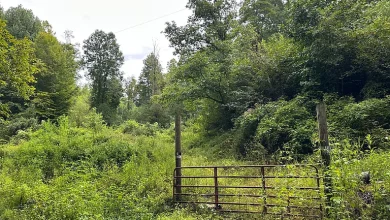
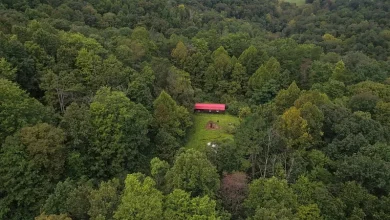
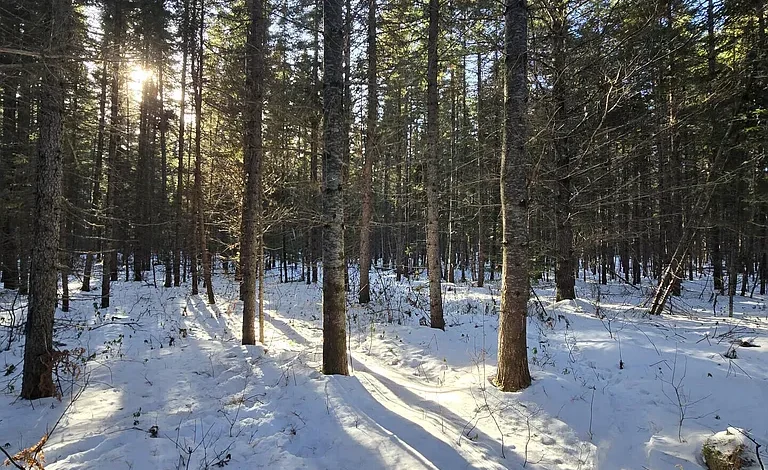
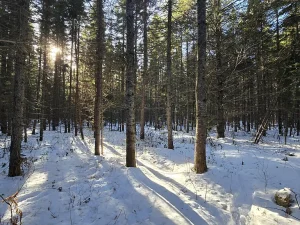
Approximately 80 percent of the property is covered by dense spruce forest, creating a landscape dominated by mature woodland character and the sights, sounds, and atmosphere of rural Maine. The terrain is described as rural, wooded, and rolling, providing a setting that may appeal to nature enthusiasts, hunters, recreational land buyers, forestry-minded investors, and individuals seeking an off-grid escape.
The property is approximately 40 to 44 acres, although no survey has been performed. Prospective buyers should verify boundaries, acreage, access, and all property details independently. Approximately 33 acres are registered in the Maine Tree Growth Tax Program, which may be an important consideration for buyers interested in long-term forest management and land stewardship.
One of the most important features of this offering is also one of its greatest limitations: the property has no legal access and no recorded easement. Access is described as being available only by rail-to-trail, and there is no established legal right-of-way. This makes the property best suited for a buyer who fully understands the challenges and responsibilities associated with remote raw land ownership.
For the right buyer, however, the lack of conventional access is part of what makes this parcel so distinctive.
A Landscape Dominated by Dense Spruce Forest
The defining feature of this property is its forest.
Approximately 80 percent of the land is covered by dense spruce trees, creating a classic northern Maine woodland environment. Spruce forests are known for their rich green color, dense growth patterns, and ability to create a secluded atmosphere.
Walking through a heavily wooded property can feel very different from standing on open land.
The forest changes the experience.
Tall trees can provide shade, privacy, and natural separation from the outside world. The sound of wind moving through evergreen branches can create a peaceful environment, while the forest floor may offer opportunities to observe wildlife, native plants, and the changing character of the landscape throughout the year.
For a landowner who values privacy, dense tree cover can be a major advantage.
The wooded environment may provide a sense of separation that is increasingly difficult to find in more developed areas.
This is a property where the land itself is the primary attraction.
There is no house to renovate and no existing structure to maintain. There are no finished rooms to update or lawns to mow. The ownership opportunity centers on the forest, the terrain, and the potential to preserve or responsibly manage a substantial piece of rural Maine land.
Approximately 40 Acres of Raw Land
The listing describes the property as approximately 40 acres, with an estimated range of roughly 40 to 44 acres because no survey has been performed.
This distinction is important.
Buyers considering raw land should understand that estimated acreage and legal surveyed acreage are not always the same. Before making a purchasing decision, a prospective buyer may wish to investigate existing deed descriptions, tax records, boundary information, and the potential benefits of obtaining a professional survey.
Even without a confirmed survey, the estimated size provides a sense of the property’s scale.
Forty acres is a substantial amount of land.
It offers significantly more privacy and room than a typical residential lot. It may provide opportunities for forest management, wildlife observation, recreation, and long-term land stewardship.
The size also means that the property can contain different micro-environments.
Some areas may be denser than others. The rolling terrain may create changes in elevation, drainage, sunlight, and vegetation. Exploring a large wooded parcel can reveal different sections of the forest, each with its own character.
Rolling Terrain and Natural Character
The property is described as having a rolling slope.
Rolling terrain can add visual and environmental variety to a forested landscape.
Rather than being completely flat, the land may include gradual changes in elevation that create different viewpoints and woodland conditions. These variations can influence tree growth, water movement, and the overall appearance of the property.
For outdoor enthusiasts, varied terrain can make a wooded property more interesting to explore.
The natural topography may provide different routes through the forest and opportunities to observe how the landscape changes across the parcel.
As with any raw land, buyers should personally inspect the terrain and evaluate it according to their intended use.
A Remote Off-Grid Property
This property is entirely off-grid.
There is no existing electric service listed on the land, and no water or sewer infrastructure is identified.
For buyers accustomed to traditional residential properties, this is a major difference.
Off-grid land ownership requires a different approach.
There are no utility bills for municipal water or sewer service because those services are not currently established. Any future development would require careful planning, permitting, engineering, and significant due diligence.
Depending on local regulations and the physical characteristics of the property, a future owner interested in development might need to investigate options for:
- Legal access
- Utility availability
- Solar power
- Battery storage
- Water supply
- Well feasibility
- Septic feasibility
- Soil conditions
- Environmental restrictions
- Building permits
- Zoning requirements
- Easement negotiations
- Road construction requirements
However, the current appeal of the property may be strongest for buyers who are not immediately seeking conventional development.
A raw forest parcel can be valuable simply as land.
It can be held for recreation, conservation, forest management, long-term investment, or personal enjoyment.
No Legal Access: An Essential Consideration
The property has no legal access.
There is no recorded easement.
This is one of the most important facts for any prospective buyer to understand.
The listing indicates that the land is accessible only by rail-to-trail, but this does not create or guarantee legal access rights. Physical ability to reach a property and legal authority to cross land are separate issues.
A buyer should not assume that a visible trail, rail corridor, neighboring route, logging path, or historical travel pattern automatically provides a permanent legal right of access.
Before purchasing, buyers should consult qualified professionals, such as a real estate attorney, title company, land surveyor, or other appropriate experts, to understand the property’s title and access situation.
Questions that may require investigation include:
- Does the deed provide any access rights?
- Is there a recorded easement?
- Are there unrecorded access claims?
- Who owns the surrounding land?
- Are there opportunities to negotiate a legal right-of-way?
- Are there restrictions related to rail corridors or trails?
- Can the property be legally accessed for timber management?
- Are there seasonal limitations on physical access?
The lack of legal access significantly affects how the land can be used.
For some buyers, this limitation may make the property unsuitable.
For others who understand the situation and have a long-term strategy, it may represent a specialized land ownership opportunity.
A Property for the Right Type of Buyer
This is not a typical home site.
It is not a conventional building lot.
It is best viewed as a remote raw land opportunity for a buyer comfortable with uncertainty, due diligence, and long-term planning.
Potential buyers may include:
- Recreational land enthusiasts
- Forestland investors
- Hunters, subject to legal access and applicable regulations
- Conservation-minded landowners
- Buyers interested in long-term timber stewardship
- Investors seeking undeveloped rural acreage
- Individuals looking for a private off-grid landholding
- Buyers interested in remote Maine wilderness
Each potential use should be independently verified.
The property’s access limitations may restrict or prevent certain activities. Buyers should not assume that recreational use, construction, logging, camping, or any other activity is automatically permitted.
The value of a property like this lies partly in understanding exactly what it is and what it is not.
It is raw.
It is wooded.
It is remote.
It is off-grid.
And it requires careful investigation before purchase.
Approximately 33 Acres in the Maine Tree Growth Tax Program
Approximately 33 acres of the property are registered in the Maine Tree Growth Tax Program.
This may be an important feature for buyers interested in forestland ownership.
Programs of this type can involve specific requirements related to forest management, land use, withdrawal, and taxation. Enrollment may affect how the property is assessed and what responsibilities a future owner assumes.
A prospective buyer should investigate the current status of the enrolled acreage before purchasing.
Important questions may include:
- What land is currently enrolled?
- Is there an existing forest management plan?
- What restrictions apply?
- Are there management requirements?
- Can the land be withdrawn from the program?
- Would withdrawal result in penalties?
- Are there required forestry practices?
- What documentation transfers to a new owner?
For a buyer interested in maintaining the forest, participation in a forest taxation program may align with long-term ownership goals.
For someone considering future development, it is especially important to understand how enrollment could affect those plans.
The dense spruce forest is not simply scenery. It may also represent a managed natural resource and a long-term stewardship responsibility.
Forest Management and Land Stewardship
Owning wooded acreage can offer a different kind of real estate experience.
Instead of maintaining a house, a landowner may focus on maintaining the health of the forest.
Responsible forest ownership can involve monitoring tree growth, observing wildlife habitat, managing invasive species, maintaining boundaries, and consulting forestry professionals when appropriate.
A dense spruce forest may require long-term thinking.
Trees grow over decades.
Forest conditions change slowly.
A landowner may decide to preserve the property in its natural condition, manage timber responsibly, or develop a formal stewardship strategy.
Professional forestry advice can help owners understand:
- Tree species composition
- Forest age and health
- Timber potential
- Wildlife habitat
- Disease concerns
- Sustainable harvesting practices
- Access requirements
- Long-term management plans
For a buyer who enjoys nature and land management, this can become part of the ownership experience.
Privacy in a Rural Maine Setting
Privacy is one of the strongest attractions of remote wooded land.
With approximately 40 acres and extensive tree cover, this property offers a setting that feels far removed from dense development.
There are no finished neighborhoods described on the property.
There is no driveway.
There are no visible residential amenities included in the listing.
Instead, the focus is on the woods.
For some buyers, this kind of privacy is exactly what they are looking for.
Modern life can be busy and constantly connected. A remote forest property offers a different environment.
The pace changes.
The soundscape changes.
Instead of traffic, there may be wind through trees.
Instead of streetlights, there may be natural darkness.
Instead of closely spaced houses, there is dense woodland.
Of course, this same remoteness also creates practical challenges. Access, safety, emergency response, and communication should all be considered before visiting or using remote property.
Potential Wildlife Habitat
A heavily wooded property can support a variety of wildlife, depending on habitat conditions and the surrounding landscape.
Dense spruce cover, rolling terrain, and substantial acreage may create environments that attract different animal species.
Potential land uses related to wildlife could include observation, photography, habitat stewardship, and recreation, subject to legal access and applicable laws.
The property may appeal to buyers who enjoy spending time outdoors and learning about the natural environment.
A future owner could potentially document wildlife activity using cameras, field observation, or professional ecological guidance.
Because the land is remote and heavily wooded, prospective buyers should exercise appropriate caution and comply with all state and local regulations.
A Long-Term Land Investment Perspective
Raw land is different from a traditional residential property.
A house may provide immediate shelter and rental potential.
Undeveloped land offers a different kind of ownership.
Its value may be connected to location, acreage, timber resources, access, surrounding land use, environmental characteristics, and future possibilities.
For long-term investors, land can represent a tangible asset with limited supply.
No new acreage is created.
However, not all land parcels have the same characteristics.
Access is one of the most important factors affecting usability and value.
Because this property has no legal access, buyers should approach any investment analysis with special care.
A low purchase price alone does not make a property a good investment.
The cost and difficulty of resolving access issues could be significant.
On the other hand, a buyer who understands the situation and sees a viable long-term strategy may view the property differently.
Professional legal and financial advice is strongly recommended for any buyer evaluating a specialized land investment.
Recreational Possibilities Subject to Access Rights
The forested setting may appeal to people interested in outdoor recreation.
Possible activities could include hiking, nature observation, photography, camping, and other outdoor pursuits, subject to legal access and applicable laws.
However, the access issue cannot be ignored.
A buyer must first have the legal right to reach and use the property.
The absence of a recorded easement may make regular access difficult or uncertain.
Anyone considering recreational ownership should investigate exactly how the property can be legally reached.
This due diligence should happen before purchase, not after.
No Existing Water or Sewer
The property has no water supply and no sewer system.
This is consistent with its status as remote raw land.
A future owner interested in creating an off-grid setup would need to evaluate the feasibility and legality of establishing water and wastewater systems.
Possible future options could require professional evaluation and local approval.
These may include:
- Drilled well systems
- Alternative water storage
- Rainwater collection where permitted
- Septic systems
- Composting systems where permitted
- Other approved wastewater solutions
None of these systems should be assumed to be possible on the property without proper investigation.
Soil conditions, setbacks, access, zoning, and local regulations can all influence development feasibility.
Rural Zoning
The property is listed with rural zoning.
Rural zoning can mean different things depending on the municipality and local land-use regulations.
Before purchasing, a buyer should contact the appropriate local and county offices to confirm permitted uses.
Important questions may include whether the property can support:
- Residential construction
- Seasonal structures
- Forestry
- Recreation
- Camping
- Access improvements
- Utility development
Because the parcel lacks legal access, zoning approval alone may not solve the challenges associated with development.
Both land-use rights and legal access must be understood.
Low Reported Annual Property Taxes
The listing reports annual property taxes of approximately $341.
Property taxes are subject to change, and buyers should independently verify current tax information with the appropriate local authority.
For some land investors, relatively low annual carrying costs can be attractive.
However, taxes are only one part of the ownership equation.
Potential buyers should also consider:
- Legal fees
- Survey costs
- Forestry consultation
- Boundary maintenance
- Access negotiations
- Insurance needs
- Land management expenses
- Program requirements
- Future development costs
A thorough ownership budget should consider both recurring and potential one-time expenses.
Exploring the Caribou Region of Northern Maine
The Caribou area is located in northern Maine, a region known for expansive forests, rural landscapes, agricultural areas, and outdoor recreation.
For buyers interested in remote land, northern Maine offers a distinctive environment.
The scale of the landscape can be part of the attraction.
There are areas where forests stretch for miles, roads become less developed, and outdoor activities play an important role in the local lifestyle.
Owning raw land in this region can provide a connection to that environment.
However, remote land ownership also requires preparation.
Weather conditions can be severe.
Winter access may be limited.
Cell service can vary.
Emergency services may be farther away than in urban areas.
These practical realities should be considered alongside the property’s natural appeal.
Due Diligence Should Be the First Priority
A buyer interested in this property should make thorough due diligence the first step.
The following issues deserve special attention:
Confirm Legal Access
The property has no legal access and no recorded easement according to the listing. A qualified real estate attorney should review the title and access situation.
Verify Property Boundaries
No survey has been performed, and the acreage is estimated. A surveyor may help establish boundaries and acreage.
Review the Tree Growth Tax Program
Approximately 33 acres are registered in the program. Buyers should understand all obligations, restrictions, and possible withdrawal consequences.
Confirm Permitted Uses
Local officials should be consulted regarding zoning, camping, construction, forestry, and other intended uses.
Inspect the Land
A personal inspection can help buyers understand the density of the forest, terrain, boundaries, and physical conditions.
Investigate Utility Feasibility
The property is off-grid with no water or sewer. Any future development should be evaluated by appropriate professionals.
Understand Physical and Legal Access
Being physically able to approach a parcel is not the same as having a legal right to access it.
Who Might Find This Property Most Appealing?
This property may be especially interesting to a buyer who:
- Values privacy above convenience
- Understands raw land transactions
- Is comfortable with off-grid conditions
- Has experience with forestland
- Wants long-term ownership rather than immediate development
- Enjoys northern Maine wilderness
- Is prepared to conduct legal and title research
- Understands the challenges of landlocked property
- Appreciates dense spruce forest
- Is interested in land stewardship
It may be less suitable for someone looking for a traditional homesite with immediate driveway access and utilities.
Understanding this difference is essential.
A Rare Opportunity for Specialized Land Ownership
Properties without legal access are specialized real estate opportunities.
They require more research than a conventional residential purchase.
Yet for the right buyer, they can offer something increasingly difficult to find: substantial acreage that remains largely undeveloped and dominated by natural forest.
The dense spruce cover is the heart of this property.
Approximately 40 acres of rural Maine land provides space, privacy, and a sense of separation from developed areas.
The land is not finished.
It is not polished.
It is not designed for immediate suburban living.
Its value lies in its raw character.
Final Thoughts
This approximately 40-acre wooded property in the Caribou region offers a distinctive opportunity for buyers seeking raw, remote, off-grid land in northern Maine.
With approximately 80 percent of the parcel covered by dense spruce forest, the property offers substantial natural privacy and a classic woodland setting. The rolling terrain and estimated 40 to 44 acres create a landscape with potential for long-term land stewardship, recreation, forest management, and personal enjoyment.
Approximately 33 acres are registered in the Maine Tree Growth Tax Program, adding another important consideration for buyers interested in responsible forest ownership.
The property’s lack of legal access and absence of a recorded easement are critical facts that must be fully investigated before purchase. Any buyer should work with qualified legal, title, surveying, forestry, and land-use professionals to understand access rights, boundaries, program requirements, and possible future uses.
For a buyer who understands these challenges, this is an opportunity to own a substantial piece of raw Maine forest.
It is a property for someone who sees value in trees rather than buildings, privacy rather than convenience, and long-term potential rather than immediate development.
In a world where increasingly more land is developed, subdivided, and connected to infrastructure, a dense forest parcel can represent something fundamentally different.
It offers the possibility of ownership over a natural landscape.
The spruce trees, rolling ground, rural setting, and remote character define the experience.
For the right owner, this is not simply 40 acres.
It is a piece of northern Maine wilderness waiting for its next chapter.
Listed on Zillow